Protection Issues
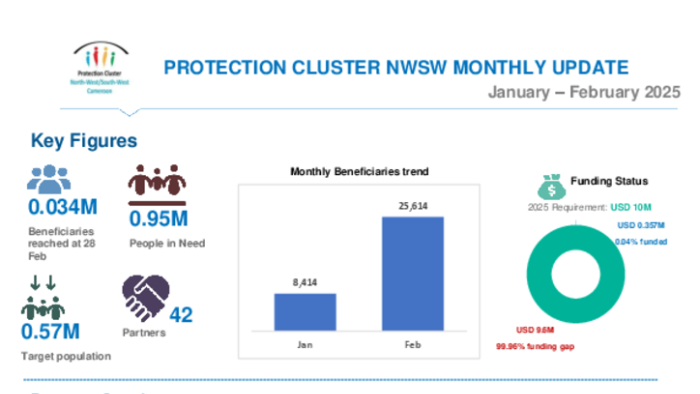
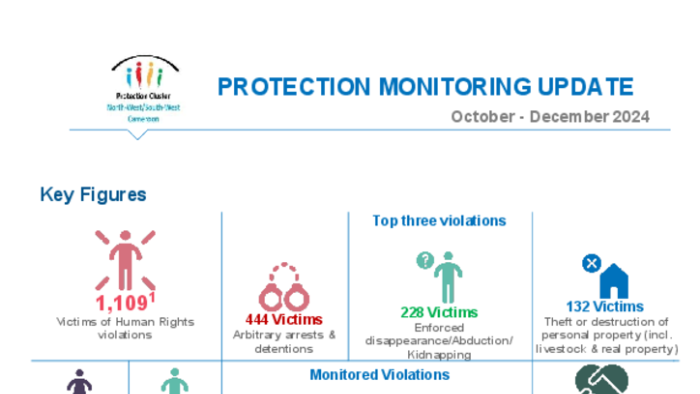
Cameroon faces a complex protection environment shaped by overlapping crises, including conflict in the North-West and South-West, insecurity and climate-related shocks in the Far North, refugee influxes, and increasing urban and mixed migration pressures. These crises continue to affect refugees, asylum seekers, internally displaced persons (IDPs), returnees, and host communities. Key protection risks include forced displacement, violence against civilians, kidnappings, arbitrary detention, extortion, gender-based violence (GBV), child protection concerns, housing, land and property disputes, and limited access to civil documentation and legal identity. In the North-West and South-West, conflict-related violence and access constraints remain severe, while in the Far North, insecurity is compounded by climate shocks and structural vulnerabilities. Urban centers such as Douala and Yaoundé face growing challenges related to documentation, inclusion, and mixed migration. Despite ongoing humanitarian reforms and global funding reductions, protection needs remain high. The Protection Sector continues to support protection analysis, coordination, advocacy, and response while advancing localization and strengthening national leadership to ensure that vulnerable populations maintain access to essential protection services.
Humanitarian Needs and Response Plan in 2026
About the Protection Cluster
Established in 2014, the Protection Sector in Cameroon serves as the national protection coordination platform supporting the Government of Cameroon and humanitarian actors in addressing protection risks. At national level, it operates as a sectoral coordination mechanism rather than a formally activated IASC Protection Cluster, providing strategic leadership on protection analysis, humanitarian planning, advocacy, service coordination, and systems strengthening. Its initial strategic framework (2016–2017) primarily focused on displacement-related protection challenges in the Far North, East, Adamawa, and North regions, reflecting the major displacement dynamics at the time, before progressively expanding to broader national protection coordination as new crises emerged. In late 2017, following the escalation of conflict and mass internal displacement in the North-West and South-West (NWSW), a formal IASC Protection Cluster was activated to coordinate emergency protection responses in these conflict-affected regions. Since then, the NWSW Protection Cluster has served as the dedicated humanitarian coordination mechanism for protection in active conflict settings, leading protection monitoring, operational coordination, advocacy, and emergency response.
Cluster Transition
Today, Cameroon’s protection architecture functions through a hybrid model combining national Protection Sector coordination, regional coordination structures, Thematic Leads, and the NWSW Protection Cluster. In the Far North, protection coordination has progressively evolved toward stronger articulation with government-led frameworks, reflecting the region’s more advanced transition environment while maintaining dedicated protection functions. The national architecture continues to ensure coherence across thematic areas including Protection Monitoring, GBV, Child Protection, HLP, civil documentation, and community-based protection. Under the 2025–2027 Transition Plan, the Protection Sector seeks to progressively consolidate these structures into a strengthened national protection coordination platform, while supporting phased transfer of leadership and operational responsibilities toward national authorities, local actors, and sustainable coordination systems. Regionally, transition modalities remain differentiated according to context, preserving dedicated protection capacities where risks remain acute. This transition reflects global humanitarian reform and financial reprioritization rather than reduced protection needs, reinforcing the continued necessity of robust, adaptive, and context-sensitive protection coordination across Cameroon.
Coordination Team

Protection Sector Coordinator
Protection Sector Information Management Officer
Child Protection Thematic Lead
Child Protection Information Management Officer
GBV Thematic Lead
GBV Information Management Analyst
HLP Thematic Lead