

Protection risks are at the centre of every humanitarian crisis and are major drivers of humanitarian needs. They occur when people are exposed to violence, coercion or deliberate deprivation — including attacks on civilians, forced displacement, gender-based violence, family separation, restrictions on movement, denial of documentation, explosive ordnance, extortion, trafficking, discrimination and psychological distress.
These risks affect people differently. Children may face family separation, forced recruitment, exploitation or denial of education; women and girls are often more exposed to gender-based violence and barriers to services; and older people and persons with disabilities may be left behind or face additional barriers during displacement and emergencies.
Across 20+ crisis-affected countries, Protection Clusters work with partners to monitor and analyse protection risks: who is most affected, where risks are most severe, what drives them, and what capacities exist to prevent, mitigate and respond to harm.
The GPC and its partners have defined a consolidated list of 15 protection risks, aligned with the Protection Analytical Framework, to support consistent analysis, advocacy and response across operations while allowing each country context to reflect its specific threats, affected groups, locations and capacities.
Country Protection Clusters produce Protection Analysis Updates to identify the most critical risks in their operational contexts and inform response planning, advocacy and decision-making. At global level, the Global Protection Update brings together country-level analysis to highlight trends and emerging patterns across the 15 protection risks.


Latest Global Protection Update
The Global Protection Update provides an overview of key global protection trends and emerging risks across crises. It is published once a year.
Global Protection Update, Protection in a Prioritised Humanitarian Response, October 2025.
Explore All Protection Risks
This protection risk includes all situations when family members are separated, including girls and boys from their parents and caregivers, because of violent conflicts, climate induced disasters...
Child marriage is any formal or informal union between a child under the age of 18 with an adult or another child. It is considered as a form of forced marriage because of the...
This protection risk includes acts that deprive or pre-empt people to rightfully access economic resources/assets or livelihood opportunities, education, health or other social services, on the...
This protection risk refers to all situations when information is used or denied with the consequence of causing harm to the population. Disinformation takes place when false information and...
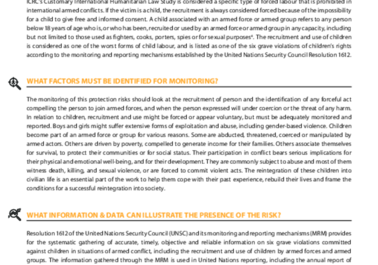
This protection risk refers to all situations in which a person is compelled to serve in the forces of a hostile power, by means of coercion, threats or other means. FThe forced recruitment is...
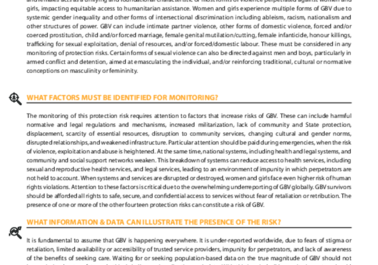
Gender-based violence is an umbrella protection risk for any harmful act that is perpetrated against a person’s will and that is based on socially ascribed (i.e., gender) differences between males...
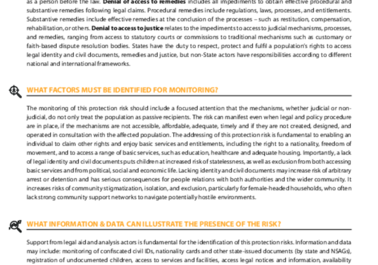
This protection risk includes all measures, acts and practice that prevents people from accessing documentation, remedies and justice with consequent harm at individual, household and community...
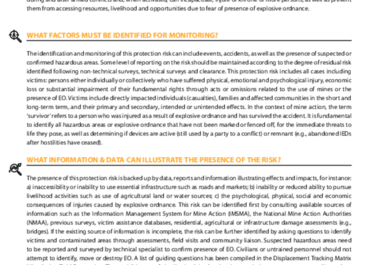
This risk refers to the level of social, economic and environmental impact on communities and affected populations resulting from the harm or exposure to harm caused by Explosive Ordnance (EO)...
Psychological and emotional abuse or the infliction of distress can refer to direct acts perpetrated with the intention of causing harm, as well as the indirect results of the...
This risk includes forms of unlawful dispossession of persons either individually or collectively involving a direct or indirect responsibility of public officials or non-State actors, either by...
This risk illustrates acts of torture by which any intentionally severe pain or suffering is inflicted on a person, whether physical or mental, for such purposes such as: a)...
This protection risk refers to forced labour, slavery, slavery-like practices and trafficking in persons. Forced labour refers to situations in which persons are coerced to work...
This protection risk refers to all restrictions and barriers to freedom of movement, including situations of isolation, siege, forced displacement and any situation when a person does not have...
This protection risk covers different acts and measures of detention, meaning the state of being deprived of liberty and being detained in a confined space and not being permitted to leave....
This protection risk refers to attacks against civilians in a context of armed conflict. Attack means any act of violence against the civilian population and civilian objects,...
