

About Protection Analysis
Protection analysis is essential to humanitarian action because it helps identify who is at risk, from what, where, why, and what must change to reduce exposure to violence, coercion and deliberate deprivation. In line with the IASC Policy on Protection in Humanitarian Action and the Centrality of Protection, it supports a shared understanding of the most critical protection risks and helps ensure that humanitarian strategies, plans and programmes are guided by the safety, rights and dignity of affected people.
For the Global Protection Cluster, protection analysis is the foundation for collective action. It enables Protection Clusters and partners to move beyond describing needs or incidents in isolation, and to analyse how threats, vulnerability, exposure and capacities interact in each context. The GPC supports this work through the Protection Analytical Framework, the 15 standard protection risks, Protection Analysis Updates and Global Protection Updates.
Through guidance, technical support and collective analysis, the GPC helps operations assess the severity of protection risks, monitor trends over time, inform Humanitarian Needs and Response Plans, guide response frameworks and protection strategies, and strengthen evidence-based advocacy. This supports coherent prioritization and programming at country and global levels, and helps ensure that humanitarian action contributes to reducing protection risks and achieving protection outcomes.
This work is informed by the GPC Information and Analysis Working Group, a GPC body that promotes collective approaches to protection analysis, decision-making, methodological development and the sharing of best practice across operations
GPC Information and Analysis Working Group
GPC foundational guidance on Protection Analysis
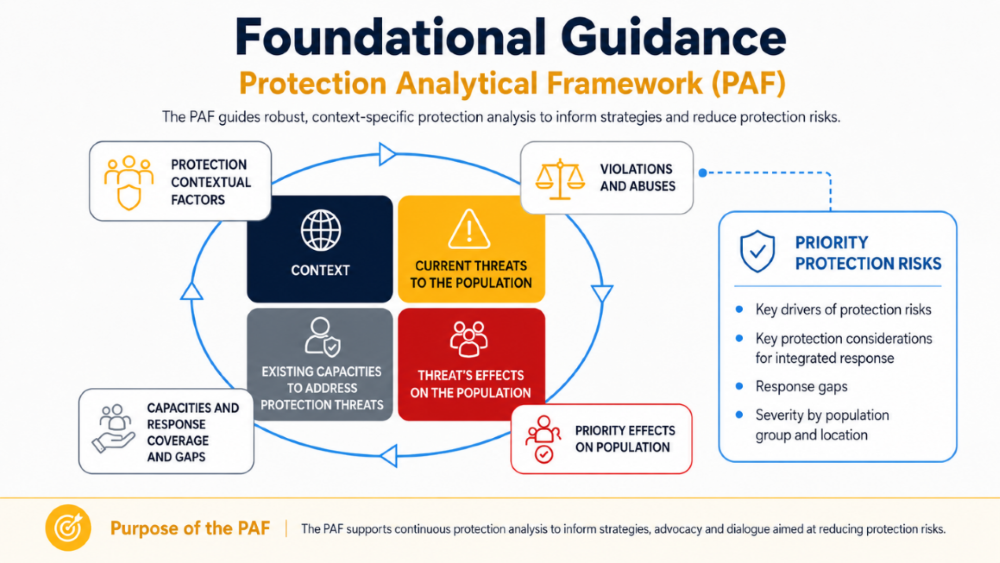
Protection Analytical Framework
The Protection Analytical Framework is the foundational reference for protection analysis, providing the common logic, concepts and structure to organize information on context, threats, effects on affected people, and capacities, and to identify priority protection risks for collective action.
The Introduction provides the scope, the purpose and the basics of the PAF. It includes all the foundational elements of the PAF, including its theoretical framework, structure and core concepts.
The Annex 1 provides a more detailed description of each PAF Pillar and Sub-pillar. It includes the standard description of each PAF elements, and provide an initial overview of the Categories to organize information and data.
This annex, Organising your data and information: the PAF Analysis Process Explained, describes how to apply the PAF in practice, principally in terms of organising data and information.
The Appendix 1: PAF Analysis Tools, includes the core tools of the PAF to use it in operation when organizing data and information for analysis.
Common Standards for Protection Risk Analysis
Agreed definitions and practical guidance to support a shared understanding of standard protection risk categories, and to help actors consistently identify, analyse and communicate protection risks across operations, including in PAUs, severity analysis, human rights-informed analysis and collective monitoring.
The Protection Risks: Explanatory note provides guidance on the use of the 15 protection risks monitored by the Global Protection Cluster.
The Annex 1: Protection risk analysis in PAUs tutorial provides a draft protection risk analysis included in the PAU Standard Sample. The document highlights the narrative protection risk analysis, highlighting how different paragraphs are drafted stemming from corresponding Protection Analytical Framework categories.
The protection risks and human rights analysis matrix provides corresponding relations between the 15 protection risks developed by the Protection Cluster and the Areas of Responsibility and human rights considerations.
The Protection Risk Severity Criteria have been developed by the GPC and the Global AoRs to guide the joined-up prioritization of protection risks.
Additional GPC Guidance for Collective Practice
Protection Analysis Updates templates and guidance
Templates and guidance to help operations prepare consistent and context-adapted PAUs, from full analysis reports to brief, thematic or sub-national updates.
The tools are available in English, French, and Spanish.
The PAU Standard sample is an analysis document fully developed on the basis of content, analysis and solutions applied by Protection Cluster during the period 2021-2022.
The PAU Brief Sample is an analysis document fully developed on the basis of content, analysis and solutions applied by Protection Cluster during the period 2021-2022.
The PAU annotated template replaces the 2021 version. It provides specific guidance on how to adapt both the PAU Standard and Brief samples to elaborate protection analysis in the context.
Operational guidance to inform collective analysis, prioritization and planning processes
Standard operational guidance and tools to inform collective analysis, prioritization and planning processes coordinated or supported by Protection Clusters, including HNRPs, intersectoral analysis, severity analysis and response planning.
The Protection Cluster Approach to Joined-Up Protection Analysis Guidance provides the overarching protection approach to coordinate analysis processes, agreed between the GPC and the Global AoRs. It provides an overview of the process, core steps and the analytical approach to analyze protection risks and resulting needs.
The Protection Risks Prioritization Tool provides an example of the tool used by Protection Cluster to assess on quarterly basis the severity of each of the 15 protection risks, in contribution to the Global Protection Updates and the Humanitarian Needs Overview.
The Protection Cluster Harmonized Information Needs Databank is the iterative database developed together by the GPC and the Global AoRs to guide data landscaping and the identification of information needs.
